'… this study presents an impressive argument through solid research and easy-to-understand analysis. With a deft hand, Levshina leads readers through a well-structured, extremely fitting thesis at a time when people commonly engage in multiple tasks and social-media distractions in a challenging environment. A minimalist 'less is more' approach is central to this volume's effectiveness. … Recommended.' K. Liu, Choice

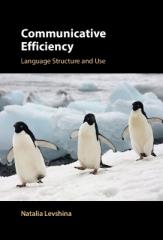
All living beings try to save effort, and humans are no exception. This groundbreaking book shows how we save time and energy during communication by unconsciously making efficient choices in grammar, lexicon and phonology. It presents a new theory of 'communicative efficiency', the idea that language is designed to be as efficient as possible, as a system of communication. The new framework accounts for the diverse manifestations of communicative efficiency across a typologically broad range of languages, using various corpus-based and statistical approaches to explain speakers' bias towards efficiency. The author's unique interdisciplinary expertise allows her to provide rich evidence from a broad range of language sciences. She integrates diverse insights from over a hundred years of research into this comprehensible new theory, which she presents step-by-step in clear and accessible language. It is essential reading for language scientists, cognitive scientists and anyone interested in language use and communication.
Read more
List of Figures ; List of Tables; Preface; Acknowledgements; List of Abbreviations; Part I. Different Types of Efficiency in Language: 1. Communicative efficiency: main concepts; 2. Efficiency and formal length; 3. Efficiency and the order of meaningful elements; 4. Other ways of saving effort; Part II. Efficiency and Language Evolution: 5. Emergence of efficient language patterns; 6. From trade-offs to causal networks; Part III. Case Studies: 7. Efficient form-meaning mapping in causative constructions; 8. Differential case marking and efficiency; 9. Efficient use of function words in English alternations; 10. Conclusions and perspectives Appendices; References; Index.
Read more
Illustrated with rich examples, this book shows how language users can save effort by choosing efficient structures and word order.

Product details

ISBN
9781108743945
Published
2025-03-13
Publisher
Cambridge University Press
Weight
451 gr
Height
229 mm
Width
152 mm
Thickness
17 mm
Age
U, 05
Language
Product language
Engelsk
Format
Product format
Heftet
Number of pages
309

Biographical note

Natalia Levshina is a Postdoctoral researcher at the Neurobiology of Language department, Max Planck Institute for Psycholinguistics. She is the author of the best-selling book How to Do Linguistics with R (2015).