

Produktdetaljer
ISBN
9780191076480
Publisert
2020
Utgiver
Oxford University Press Academic UK
Språk
Product language
Engelsk
Format
Product format
Digital bok
Forfatter
Digital bok /
2020
/ Engelsk
168,-
Laveste pris siste 30 dager: 168,-
Dette er en digital bok som er bundet til bokleseren Bookshelf. Du vil få en aktiveringslenke på e-post når du har fullført kjøpet.
Klikk her for mer info.
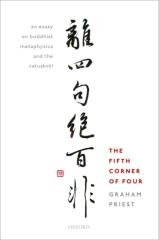

Graham Priest presents an exploration of Buddhist metaphysics, drawing
on texts which include those of Nãgãrjuna and Dõgen. The
development of Buddhist metaphysics is viewed through the lens of the
catuṣkoṭi. At its simplest, and as it appears in the earliest
texts, this is a logical/ metaphysical principle which says that every
claim is true, false, both, or neither; but the principle itself
evolves, assuming new forms, as the metaphysics develops. An important
step in the evolution incorporates ineffability. Such things make no
sense from the perspective of a logic which endorses the principles of
excluded middle and non-contradiction, which are standard fare in
Western logic. However, the book shows how one can make sense of them
by applying the techniques of contemporary non-classical logic, such
as those of First Degree Entailment, and Plurivalent Logic. An
important issue that emerges as the book develops is the notion of
non-duality and its transcendence. This allows many of the threads of
the book to be drawn together at its end. All matters are explained,
in as far as possible, in a way that is accessible to those with no
knowledge of Buddhist philosophy or contemporary non-classical logic.
Les mer
An Essay on Buddhist Metaphysics and the Catuṣkoṭi
Graham Priest presents an exploration of Buddhist metaphysics, drawing
on texts which include those of Nãgãrjuna and Dõgen. The
development of Buddhist metaphysics is viewed through the lens of the
catuṣkoṭi. At its simplest, and as it appears in the earliest
texts, this is a logical/ metaphysical principle which says that every
claim is true, false, both, or neither; but the principle itself
evolves, assuming new forms, as the metaphysics develops. An important
step in the evolution incorporates ineffability. Such things make no
sense from the perspective of a logic which endorses the principles of
excluded middle and non-contradiction, which are standard fare in
Western logic. However, the book shows how one can make sense of them
by applying the techniques of contemporary non-classical logic, such
as those of First Degree Entailment, and Plurivalent Logic. An
important issue that emerges as the book develops is the notion of
non-duality and its transcendence. This allows many of the threads of
the book to be drawn together at its end. All matters are explained,
in as far as possible, in a way that is accessible to those with no
knowledge of Buddhist philosophy or contemporary non-classical logic.
Les mer
An Essay on Buddhist Metaphysics and the Catuṣkoṭi
Produktdetaljer
ISBN
9780191076480
Publisert
2020
Utgiver
Oxford University Press Academic UK
Språk
Product language
Engelsk
Format
Product format
Digital bok
Forfatter