

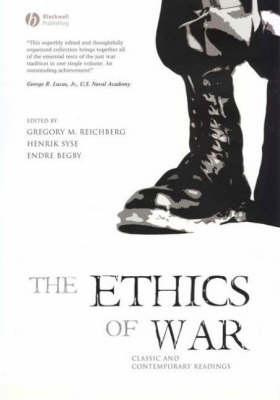
Ethics of War Classic and Contemporary Readings
Produktdetaljer
Biografisk notat
Gregory M. Reichberg is Senior Researcher at the International Peace Research Institute, Oslo (PRIO) where he heads the Institute's Program on Ethics, Norms, and Identities. He is editor of The Classics of Western Philosophy: A Reader's Guide (with Jorge J. E. Gracia and Bernard N. Schumacher, Blackwell 2003) and he has published numerous articles on the ethics of war and peace.
Henrik Syse is Senior Researcher associated with PRIO and the Ethics Program at the University of Oslo, and Head of Corporate Governance at Norges Bank Investment Management. He is the author of Natural Law, Religion, and Rights (2006).
Endre Begby is Fulbright Fellow in the Department of Philosophy at the University of Pittsburgh.
Ethics of War Classic and Contemporary Readings


<p>"This is a superb, comprehensive collection of the basic texts that make up the just war tradition. Some have been very difficult to get hold of and others have been translated for the first time. It will be an indispensable resource for all departments of international affairs, ethics, war studies, peace studies and many history departments." (<i>Times Higher Education,</i> 25 May 2007)</p> <p>"As a collection of key readings, each prefaced by editorial comment, it can scarcely be bettered." (<i>The Times</i>)</p> <p>"An invaluable resource for many readers for years to come...anyone interested in the history of western thought on the subject of war will find [the volume] fascinating." (<i>Peace News</i>)</p>
The Ethics of War is an indispensable collection of essays addressing issues both timely and age-old about the nature and ethics of war.
- Features essays by great thinkers from ancient times through to the present day, among them Plato, Augustine, Aquinas, Machiavelli, Grotius, Kant, Russell, and Walzer
- Examines timely questions such as: When is recourse to arms morally justifiable? What moral constraints should apply to military conduct? How can a lasting peace be achieved?
- Will appeal to a broad range of readers interested in morality and ethics in war time
- Includes informative introductions and helpful marginal notes by editors
Preface viii
Acknowledgments xiii
Part I Ancient and Early Christian 1
1 Thucydides (ca. 460-ca. 400 BC): War and Power 3
2 Plato (427-347 BC): Tempering War among the Greeks 18
3 Aristotle (384-322 BC): Courage, Slavery, and Citizen Soldiers 31
4 Roman Law of War and Peace (Seventh Century BC-First Century AD): Ius Fetiale 47
5 Cicero (106-43 BC): Civic Virtue as the Foundation of Peace 50
6 Early Church Fathers (Second to Fourth Centuries): Pacifism and Defense of the Innocent 60
7 Augustine (354-430): Just War in the Service of Peace 70
Part II Medieval 91
8 Medieval Peace Movements (975-1123): Religious Limitations on Warfare 93
9 The Crusades (Eleventh to Thirteenth Centuries): Christian Holy War 98
10 Gratian and the Decretists (Twelfth Century): War and Coercion in the Decretum 104
11 John of Salisbury (ca. 1115-1180): The Challenge of Tyranny 125
12 Raymond of Peñafort (ca. 1180-1275) and William of Rennes (Thirteenth Century): The Conditions of Just War, Self-defense, and their Legal Consequences under Penitential Jurisdiction 131
13 Innocent IV (ca. 1180-1254): The Kinds of Violence and the Limits of Holy War 148
14 Alexander of Hales (ca. 1185-1245): Virtuous Dispositions in Warfare 156
15 Hostiensis (ca. 1200-1271): A Typology of Internal and External War 160
16 Thomas Aquinas (ca. 1225-1274): Just War and Sins against Peace 169
17 Dante Alighieri (1265-1321): Peace by Universal Monarchy 199
18 Bartolus of Saxoferrato (ca. 1313-1357): Roman War within Christendom 203
19 Christine de Pizan (ca. 1364-ca. 1431): War and Chivalry 210
20 Raphaël Fulgosius (1367-1427): Just War Reduced to Public War 227
Part III Late Scholastic and Reformation 231
21 Erasmus of Rotterdam (1466-1536): The Spurious "Right to War" 233
22 Cajetan (1468-1534): War and Vindicative Justice 240
23 Niccolò Machiavelli (1469-1527): War is Just to Whom it is Necessary 251
24 Thomas More (ca. 1478-1535): Warfare in Utopia 259
25 Martin Luther (1483-1546) and Jean Calvin (1509-1564): Legitimate War in Reformed Christianity 265
26 The Radical Reformation (Sixteenth Century): Religious Rationales for Violence and Pacifism 278
27 Francisco de Vitoria (ca. 1492-1546): Just War in the Age of Discovery 288
28 Luis de Molina (1535-1600): Distinguishing War from Punishment 333
29 Francisco Suárez (1548-1617): Justice, Charity, and War 339
30 Alberico Gentili (1552-1608): The Advantages of Preventive War 371
31 Johannes Althusius (1557-1638): Defending the Commonwealth 378
32 Hugo Grotius (1583-1645): The Theory of Just War Systematized 385
Part IV Modern 439
33 Thomas Hobbes (1588-1679): Solving the Problem of Civil War 441
34 Baruch Spinoza (1632-1677): The Virtue of Peace 451
35 Samuel von Pufendorf (1632-1694): War in an Emerging System of States 454
36 John Locke (1632-1704): The Rights of Man and the Limits of Just Warfare 462
37 Christian von Wolff (1679-1754): Bilateral Rights of War 469
38 Montesquieu (1689-1755): National Self-preservation and the Balance of Power 475
39 Jean-Jacques Rousseau (1712-1778): Supranational Government and Peace 480
40 Emer de Vattel (1714-1767): War in Due Form 504
41 Immanuel Kant (1724-1804): Cosmopolitan Rights, Human Progress, and Perpetual Peace 518
42 G. W. F. Hegel (1770-1831): War and the Spirit of the Nation-state 542
43 Carl von Clausewitz (1780-1831): Ethics and Military Strategy 553
44 Daniel Webster (1782-1852): The Caroline Incident (1837) 562
45 Francis Lieber (1800-1872): Devising a Military Code of Conduct 565
46 John Stuart Mill (1806-1873): Foreign Intervention and National Autonomy 574
47 Karl Marx (1818-1883) and Friedrich Engels (1820-1895): War as an Instrument of Emancipation 586
Part V Twentieth Century 593
48 Woodrow Wilson (1856-1924): The Dream of a League of Nations 595
49 Bertrand Russell (1872-1970): Pacifism and Modern War 600
50 Hans Kelsen (1881-1973): Bellum Iustum in International Law 605
51 Paul Ramsey (1913-1988): Nuclear Weapons and Legitimate Defense 614
52 G. E. M. Anscombe (1919-2001): The Moral Recklessness of Pacifism 625
53 John Rawls (1921-2002): The Moral Duties of Statesmen 633
54 Michael Walzer (b. 1935): Terrorism and Ethics 642
55 Thomas Nagel (b. 1937): The Logic of Hostility 653
56 James Turner Johnson (b. 1938): Contemporary Just War 660
57 National Conference of Catholic Bishops (1983 and 1993): A Presumption against War 669
58 Kofi Annan (b. 1938): Toward a New Definition of Sovereignty 683
Index 694
The Ethics of War is a much-needed anthology addressing issues both timely and age-old about the nature of war. When is recourse to arms morally justifiable? What moral constraints should apply to military conduct? How can a lasting peace be achieved? Over the past two and a half millennia a substantive body of ethical reflection has emerged in response to these and similar questions. This volume offers a collection of texts by ancient, medieval, and modern thinkers.
Never before have such seminal texts on the ethics of war been gathered together in a single volume. The Ethics of War is an indispensable resource for philosophers, students, and general readers alike.
"On balance...The Ethics of War will serve as a tremendous resource for students, teachers and writers for decades to come. We owe its editors much gratitude for their diligent compilation of a tremendous range of texts, and their careful scholarly analysis of the arguments to be found within them."
—David L. Perry, United States Army War College
"This superbly edited and thoughtfully organized collection brings together all of the essential texts of the just war tradition in one single volume. An outstanding achievement!"
—George R. Lucas, Jr., U.S. Naval Academy
"A unique and extremely well-done collection of essays culled from every period of Western history – some of which were previously unavailable in English. This is an important anthology, one that should be read and re-read by any serious student of the perennial ethical problems of warfare."
—Carl Ficarotta, US Air Force Academy
"This magnificent volume allows readers both to learn about the past and from the past. It will be of great value to historians, while those who are concerned with the burning current issues of just war will appreciate the depth of analysis of their predecessors."
—Jon Elster, Collège de France
<p>"This is a superb, comprehensive collection of the basic texts that make up the just war tradition. Some have been very difficult to get hold of and others have been translated for the first time. It will be an indispensable resource for all departments of international affairs, ethics, war studies, peace studies and many history departments." (<i>Times Higher Education,</i> 25 May 2007)</p> <p>"As a collection of key readings, each prefaced by editorial comment, it can scarcely be bettered." (<i>The Times</i>)</p> <p>"An invaluable resource for many readers for years to come...anyone interested in the history of western thought on the subject of war will find [the volume] fascinating." (<i>Peace News</i>)</p>
The Ethics of War is an indispensable collection of essays addressing issues both timely and age-old about the nature and ethics of war.
- Features essays by great thinkers from ancient times through to the present day, among them Plato, Augustine, Aquinas, Machiavelli, Grotius, Kant, Russell, and Walzer
- Examines timely questions such as: When is recourse to arms morally justifiable? What moral constraints should apply to military conduct? How can a lasting peace be achieved?
- Will appeal to a broad range of readers interested in morality and ethics in war time
- Includes informative introductions and helpful marginal notes by editors
Preface viii
Acknowledgments xiii
Part I Ancient and Early Christian 1
1 Thucydides (ca. 460-ca. 400 BC): War and Power 3
2 Plato (427-347 BC): Tempering War among the Greeks 18
3 Aristotle (384-322 BC): Courage, Slavery, and Citizen Soldiers 31
4 Roman Law of War and Peace (Seventh Century BC-First Century AD): Ius Fetiale 47
5 Cicero (106-43 BC): Civic Virtue as the Foundation of Peace 50
6 Early Church Fathers (Second to Fourth Centuries): Pacifism and Defense of the Innocent 60
7 Augustine (354-430): Just War in the Service of Peace 70
Part II Medieval 91
8 Medieval Peace Movements (975-1123): Religious Limitations on Warfare 93
9 The Crusades (Eleventh to Thirteenth Centuries): Christian Holy War 98
10 Gratian and the Decretists (Twelfth Century): War and Coercion in the Decretum 104
11 John of Salisbury (ca. 1115-1180): The Challenge of Tyranny 125
12 Raymond of Peñafort (ca. 1180-1275) and William of Rennes (Thirteenth Century): The Conditions of Just War, Self-defense, and their Legal Consequences under Penitential Jurisdiction 131
13 Innocent IV (ca. 1180-1254): The Kinds of Violence and the Limits of Holy War 148
14 Alexander of Hales (ca. 1185-1245): Virtuous Dispositions in Warfare 156
15 Hostiensis (ca. 1200-1271): A Typology of Internal and External War 160
16 Thomas Aquinas (ca. 1225-1274): Just War and Sins against Peace 169
17 Dante Alighieri (1265-1321): Peace by Universal Monarchy 199
18 Bartolus of Saxoferrato (ca. 1313-1357): Roman War within Christendom 203
19 Christine de Pizan (ca. 1364-ca. 1431): War and Chivalry 210
20 Raphaël Fulgosius (1367-1427): Just War Reduced to Public War 227
Part III Late Scholastic and Reformation 231
21 Erasmus of Rotterdam (1466-1536): The Spurious "Right to War" 233
22 Cajetan (1468-1534): War and Vindicative Justice 240
23 Niccolò Machiavelli (1469-1527): War is Just to Whom it is Necessary 251
24 Thomas More (ca. 1478-1535): Warfare in Utopia 259
25 Martin Luther (1483-1546) and Jean Calvin (1509-1564): Legitimate War in Reformed Christianity 265
26 The Radical Reformation (Sixteenth Century): Religious Rationales for Violence and Pacifism 278
27 Francisco de Vitoria (ca. 1492-1546): Just War in the Age of Discovery 288
28 Luis de Molina (1535-1600): Distinguishing War from Punishment 333
29 Francisco Suárez (1548-1617): Justice, Charity, and War 339
30 Alberico Gentili (1552-1608): The Advantages of Preventive War 371
31 Johannes Althusius (1557-1638): Defending the Commonwealth 378
32 Hugo Grotius (1583-1645): The Theory of Just War Systematized 385
Part IV Modern 439
33 Thomas Hobbes (1588-1679): Solving the Problem of Civil War 441
34 Baruch Spinoza (1632-1677): The Virtue of Peace 451
35 Samuel von Pufendorf (1632-1694): War in an Emerging System of States 454
36 John Locke (1632-1704): The Rights of Man and the Limits of Just Warfare 462
37 Christian von Wolff (1679-1754): Bilateral Rights of War 469
38 Montesquieu (1689-1755): National Self-preservation and the Balance of Power 475
39 Jean-Jacques Rousseau (1712-1778): Supranational Government and Peace 480
40 Emer de Vattel (1714-1767): War in Due Form 504
41 Immanuel Kant (1724-1804): Cosmopolitan Rights, Human Progress, and Perpetual Peace 518
42 G. W. F. Hegel (1770-1831): War and the Spirit of the Nation-state 542
43 Carl von Clausewitz (1780-1831): Ethics and Military Strategy 553
44 Daniel Webster (1782-1852): The Caroline Incident (1837) 562
45 Francis Lieber (1800-1872): Devising a Military Code of Conduct 565
46 John Stuart Mill (1806-1873): Foreign Intervention and National Autonomy 574
47 Karl Marx (1818-1883) and Friedrich Engels (1820-1895): War as an Instrument of Emancipation 586
Part V Twentieth Century 593
48 Woodrow Wilson (1856-1924): The Dream of a League of Nations 595
49 Bertrand Russell (1872-1970): Pacifism and Modern War 600
50 Hans Kelsen (1881-1973): Bellum Iustum in International Law 605
51 Paul Ramsey (1913-1988): Nuclear Weapons and Legitimate Defense 614
52 G. E. M. Anscombe (1919-2001): The Moral Recklessness of Pacifism 625
53 John Rawls (1921-2002): The Moral Duties of Statesmen 633
54 Michael Walzer (b. 1935): Terrorism and Ethics 642
55 Thomas Nagel (b. 1937): The Logic of Hostility 653
56 James Turner Johnson (b. 1938): Contemporary Just War 660
57 National Conference of Catholic Bishops (1983 and 1993): A Presumption against War 669
58 Kofi Annan (b. 1938): Toward a New Definition of Sovereignty 683
Index 694
The Ethics of War is a much-needed anthology addressing issues both timely and age-old about the nature of war. When is recourse to arms morally justifiable? What moral constraints should apply to military conduct? How can a lasting peace be achieved? Over the past two and a half millennia a substantive body of ethical reflection has emerged in response to these and similar questions. This volume offers a collection of texts by ancient, medieval, and modern thinkers.
Never before have such seminal texts on the ethics of war been gathered together in a single volume. The Ethics of War is an indispensable resource for philosophers, students, and general readers alike.
"On balance...The Ethics of War will serve as a tremendous resource for students, teachers and writers for decades to come. We owe its editors much gratitude for their diligent compilation of a tremendous range of texts, and their careful scholarly analysis of the arguments to be found within them."
—David L. Perry, United States Army War College
"This superbly edited and thoughtfully organized collection brings together all of the essential texts of the just war tradition in one single volume. An outstanding achievement!"
—George R. Lucas, Jr., U.S. Naval Academy
"A unique and extremely well-done collection of essays culled from every period of Western history – some of which were previously unavailable in English. This is an important anthology, one that should be read and re-read by any serious student of the perennial ethical problems of warfare."
—Carl Ficarotta, US Air Force Academy
"This magnificent volume allows readers both to learn about the past and from the past. It will be of great value to historians, while those who are concerned with the burning current issues of just war will appreciate the depth of analysis of their predecessors."
—Jon Elster, Collège de France
Produktdetaljer
Biografisk notat
Gregory M. Reichberg is Senior Researcher at the International Peace Research Institute, Oslo (PRIO) where he heads the Institute's Program on Ethics, Norms, and Identities. He is editor of The Classics of Western Philosophy: A Reader's Guide (with Jorge J. E. Gracia and Bernard N. Schumacher, Blackwell 2003) and he has published numerous articles on the ethics of war and peace.
Henrik Syse is Senior Researcher associated with PRIO and the Ethics Program at the University of Oslo, and Head of Corporate Governance at Norges Bank Investment Management. He is the author of Natural Law, Religion, and Rights (2006).
Endre Begby is Fulbright Fellow in the Department of Philosophy at the University of Pittsburgh.