

Produktdetaljer
Biografisk notat
A. J. Bartlett is Adjunct Research Fellow at the Research Unit in European Philosophy at Monash University. He is the author of Badiou and Plato: An Education by Truths (Edinburgh University Press, hb 2011, pb 2015) and translator, with Alex Ling, of Badiou's Mathematics of the Transcendental (Bloomsbury Academic, 2014). Justin Clemens is Associate Professor in Culture and Communication at the University of Melbourne. He has published extensively on psychoanalysis, contemporary European philosophy and Australian art and literature. His recent books include What is Education? edited with A.J. Bartlett and The Afterlives of Georges Perec edited with Rowan Wilken. Jon Roffe teaches philosophy at the Melbourne School of Continental Philosophy. He is the author of Gilles Deleuze’s Empiricism and Subjectivity (Edinburgh University Press, 2017), Abstract Market Theory (Palgrave, 2015) and Badiou’s Deleuze (Acumen 2012). He is the co-author of Deleuze’s Philosophical Lineage II (Edinburgh University Press, 2019) and Deleuze’s Philosophical Lineage (Edinburgh University Press, 2009), Practising with Deleuze (Edinburgh University Press, 2017) and Lacan Deleuze Badiou (Edinburgh University Press, 2013), and co-editor of a number of volumes on 20th-century French thought.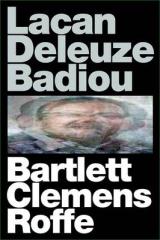

This book is perversely brilliant in its eclecticism. The authors thread their way through the topics of contemporaneity, time, the Event, and truth/Truth, swerving between Badiou, Deleuze, and Lacan. In the process of this tour de force, they take in much of the landscape of contemporary philosophy and anti-philosophy.
Henry Krips, Claremont Graduate University
This is a fierce ride through the tangled relations of Lacan, Deleuze and Badiou. Readers will thrill to its edginess, intuitions, learning and irreverence. It would be easy to be thrown, though, hurt and bemused by a wild swirl of ideas. Inspect it warily, before mounting only if it suits.
James Williams, University of Dundee
This book is perversely brilliant in its eclecticism. The authors thread their way through the topics of contemporaneity, time, the Event, and truth/Truth, swerving between Badiou, Deleuze, and Lacan. In the process of this tour de force, they take in much of the landscape of contemporary philosophy and anti-philosophy.
- Henry Krips, Claremont Graduate University,
This is a fierce ride through the tangled relations of Lacan, Deleuze and Badiou. Readers will thrill to its edginess, intuitions, learning and irreverence. It would be easy to be thrown, though, hurt and bemused by a wild swirl of ideas. Inspect it warily, before mounting only if it suits.
- James Williams, University of Dundee,
This book is perversely brilliant in its eclecticism. The authors thread their way through the topics of contemporaneity, time, the Event, and truth/Truth, swerving between Badiou, Deleuze, and Lacan. In the process of this tour de force, they take in much of the landscape of contemporary philosophy and anti-philosophy.
Henry Krips, Claremont Graduate University
This is a fierce ride through the tangled relations of Lacan, Deleuze and Badiou. Readers will thrill to its edginess, intuitions, learning and irreverence. It would be easy to be thrown, though, hurt and bemused by a wild swirl of ideas. Inspect it warily, before mounting only if it suits.
James Williams, University of Dundee
This book is perversely brilliant in its eclecticism. The authors thread their way through the topics of contemporaneity, time, the Event, and truth/Truth, swerving between Badiou, Deleuze, and Lacan. In the process of this tour de force, they take in much of the landscape of contemporary philosophy and anti-philosophy.
- Henry Krips, Claremont Graduate University,
This is a fierce ride through the tangled relations of Lacan, Deleuze and Badiou. Readers will thrill to its edginess, intuitions, learning and irreverence. It would be easy to be thrown, though, hurt and bemused by a wild swirl of ideas. Inspect it warily, before mounting only if it suits.
- James Williams, University of Dundee,