

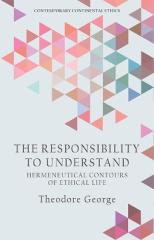
Responsibility to Understand Hermeneutical Contours of Ethical Life
Produktdetaljer
Biografisk notat
Theodore George is Associate Professor of Philosophy at Texas A&M University. He is the author of Tragedies of Spirit: Tracing Finitude in Hegel’s Phenomenology (SUNY, 2006). He is co-editor of The Gadamerian Mind (Routledge, forthcoming) and Philosophers and their Poets: On the Poetic Turn in German Philosophy since Kant (SUNY, 2019). He is the translator of Objectivity: The Hermeneutical and Philosophy by Günter Figal (SUNY, 2010).Responsibility to Understand Hermeneutical Contours of Ethical Life

Theodore George’s book The Responsibility to Understand: Hermeneutical Contours of Ethical Life is a sensitive, thoughtful, and insightful invocation to rehabilitate connection and the relational capacity of our lives. This book not only invites an internal reflection of the ways I live in the world and keep in relationship to others in it, but it deeply connects to the work we do in practice professions. Like Gadamer, George offers us a sophisticated practice philosophy that resonates and coalesces with our human endeavours of understanding each other in the context of urgent social and global concerns and fundamental human experiences of suffering, pain, joy, loss, and love.
- Nancy J. Moules, University of Calgary, Journal of Applied Hermeneutics
A sensitive, thoughtful, and insightful invocation to rehabilitate connection and the relational capacity of our lives. This book not only invites an internal reflection of the ways I live in the world and keep in relationship to others in it, but it deeply connects to the work we do in practice professions. Like Gadamer, George offers us a sophisticated practice philosophy that resonates and coalesces with our human endeavours of understanding each other in the context of urgent social and global concerns and fundamental human experiences of suffering, pain, joy, loss, and love.
- Nancy J. Moules, University of Calgary, Journal of Applied Hermeneutics
George’s book is both excellent and illuminating [...] As a reader one feels guided by someone who wants to hold together multiple strands of thought and yet remain himself in the process. More than this, however, the reader is led by someone who has immersed himself in the works and words of the tradition, and someone who is at home there.
- Niall Keane, Research In Phenomenology
In this excellent contribution to both ethics and hermeneutics, George offers a clear argument why present-day discussions on responsibility should engage with the insights of philosophical hermeneutics. The hermeneutic emphasis on understanding, as this study convincingly argues, is to be understood as a responsibility to understand.
- Gert-Jan van der Heiden, Radboud University,
Theodore George’s book The Responsibility to Understand: Hermeneutical Contours of Ethical Life is a sensitive, thoughtful, and insightful invocation to rehabilitate connection and the relational capacity of our lives. This book not only invites an internal reflection of the ways I live in the world and keep in relationship to others in it, but it deeply connects to the work we do in practice professions. Like Gadamer, George offers us a sophisticated practice philosophy that resonates and coalesces with our human endeavours of understanding each other in the context of urgent social and global concerns and fundamental human experiences of suffering, pain, joy, loss, and love.
- Nancy J. Moules, University of Calgary, Journal of Applied Hermeneutics
A sensitive, thoughtful, and insightful invocation to rehabilitate connection and the relational capacity of our lives. This book not only invites an internal reflection of the ways I live in the world and keep in relationship to others in it, but it deeply connects to the work we do in practice professions. Like Gadamer, George offers us a sophisticated practice philosophy that resonates and coalesces with our human endeavours of understanding each other in the context of urgent social and global concerns and fundamental human experiences of suffering, pain, joy, loss, and love.
- Nancy J. Moules, University of Calgary, Journal of Applied Hermeneutics
George’s book is both excellent and illuminating [...] As a reader one feels guided by someone who wants to hold together multiple strands of thought and yet remain himself in the process. More than this, however, the reader is led by someone who has immersed himself in the works and words of the tradition, and someone who is at home there.
- Niall Keane, Research In Phenomenology
In this excellent contribution to both ethics and hermeneutics, George offers a clear argument why present-day discussions on responsibility should engage with the insights of philosophical hermeneutics. The hermeneutic emphasis on understanding, as this study convincingly argues, is to be understood as a responsibility to understand.
- Gert-Jan van der Heiden, Radboud University,