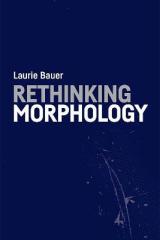
Rethinking Morphology is a lively and accessible tour of word-formation patterns and theories of morphology. It offers excellent insights into the strong suits of different classical approaches, also laying out the motivation for more recent cognitively-based views. It will be equally useful as a textbook and as a reference work for researchers in related fields.

- Professor Janet B. Pierrehumbert, University of Oxford,

Different theoretical positions can lead to conflicting restrictions on our understanding of what morphology is about. In this textbook, Laurie Bauer presents a new way of thinking about morphological structure – one that will maximise our benefits from the existing disparate approaches available. Presenting a clear and critical overview, this book equips students with the tools to discuss morphological phenomena and to do so in relation to other linguistic contexts, including semantics, psycholinguistics and language change. Structured around the core areas of morphemic theory, word morphology, word syntax, the boundaries of morphology, and exemplars and resonances, each chapter discusses the limits, strengths and wider implications of existing theories and issues surrounding these facets of morphology.
Les mer
Presenting a clear and critical overview, this book equips students with the tools to discuss morphological phenomena and to do so in relation to other linguistic contexts, including semantics, psycholinguistics and language change.
Les mer
Acknowledgements Abbreviations and notational conventions 1 Introduction 1.1 Morphology and the word 1.2 Theory and description 1.3 About this book Notes and comments Reading Discussion questions 2 Morpheme-based morphology 2.1 A sketch morphemic model 2.2 Problems for the morpheme 2.2.1 How much similarity of form must allomorphs share? 2.2.2 How much similarity of meaning must allomorphs share? 2.2.3 What are the limits of analysis? 2.2.4 Empty morphs 2.2.5 Zero morphs 2.2.6 Processes as morphs 2.2.7 Cumulative exponence 2.2.8 Extended exponence 2.2.9 Superfluous morphs 2.2.10 Morphs with incompatible meanings 2.2.11 Inversion 2.3 Evaluation 2.4 An alternative Notes and comments Reading Discussion questions 3 Word-based morphology 3.1 Introduction 3.2 The fundamentals of such a model 3.3 Two potential criticisims of word-based morphology 3.4 Inflection and derivation 3.4.1 Questions of definition 3.4.2 The inflection-derivation split 3.5 What if there is no inflection-derivation split? Notes and comments Reading Discussion questions 4. Word syntax 4.1 Introduction 4.2 Some basics 4.3 Headedness 4.4 Morphotactics 4.5 Conclusion Notes and comments Reading Discussion questions 5 The phonological correlates of concatenation 5.1 Introduction 5.2 Deletion of phonological material 5.2.1 Haplology 5.2.2 Truncation 5.3 Addition of phonological material 5.4 The modification of phonological material 5.4.1 Assimilation 5.4.2 Remnants of historical processes 5.4.3 Cluster simplification 5.4.4 Structure optimisation 5.5 Wider phonological change 5.6 Conclusion Notes and comments Reading Discussion questions 6. The borders of morphology 6.1 Introduction 6.2 Meaning without form 6.3 Form without meaning 6.4 Acronyms 6.5 Phonaesthemes 6.6 Blends 6.7 Clippings 6.8 Yiddish-influences shm- 6.9 Backformation 6.10 Messy formations and the limits of description 6.11 Analogy Notes and comments Reading Discussion questions 7 Exemplars and resonances 7.1 Interlude: the acquisition of phonemes 7.2 Acquiring morphology 7.3 Exemplar theory 7.4 Resonances 7.5 Why is an approach based on exemplar theory and resonances an improvement? 7.5.1 Morphemes 7.5.2 Unique outcomes 7.5.3 Inflection and derivation 7.5.4 Morphotactics 7.5.5 Headedness 7.5.6 Lack of compositionality 7.5.7 Productivity 7.5.8 Typology and naturalness 7.6 Is there anything that this kind of approach cannot explain? 7.7 Examples 7.8 Conclusion Notes and comments Reading Discussion questions Glossary References Index
Les mer

Produktdetaljer

ISBN
9781474436168
Publisert
2019-02-11
Utgiver
Edinburgh University Press
Vekt
206 gr
Høyde
216 mm
Bredde
138 mm
Aldersnivå
P, 06
Språk
Product language
Engelsk
Format
Product format
Heftet
Antall sider
160

Forfatter

Biografisk notat

Laurie Bauer is Professor of Linguistics at the Victoria University of Wellington. He is on the editorial board of the journal Word Structure.