

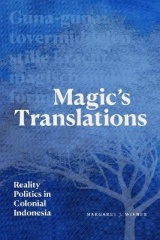
Magic's Translations Reality Politics in Colonial Indonesia
Produktdetaljer
Biografisk notat
Margaret J. Wiener is Associate Professor of Anthropology at the University of North Carolina at Chapel Hill, and author of Visible and Invisible Realms: Power, Magic, and Colonial Conquest in Bali.Isabelle Stengers is Emerita Professor of the Philosophy of Science at the UniversitÉ libre de Bruxelles.
Magic's Translations Reality Politics in Colonial Indonesia


“Margaret J. Wiener gives the concept of magic, long central to but recently dormant in anthropology, new relevance. She shows how magic is relational and highlights its importance in colonizing projects, where worlds are remade through denunciations of fetishes and fanaticisms in the name of European realism and modernism. I cannot think of any other work that constructs this particular argument so thoroughly. <i>Magic’s Translations</i> is an inspiring book.” - Stephen Muecke, Emeritus Professor of Ethnography, University of New South Wales “Margaret J. Wiener’s <i>Magic’s Translations</i> offers a reading that changes for history what magic is and what it has never been. At the crossroads of actor network theory and postcolonial studies, she boldly reconceptualizes magic; in the process, she adds historical and political nuance to the former and challenges the latter beyond the comfort zones of historical interpretation and epistemology. <i>Magic’s Translations</i> will have enormous staying power in feminist studies and decolonial studies and will appeal to scholars of science and technology studies, history, philosophy, and literature. It will also appeal to readers and the public beyond any disciplinary walls.” - Marisol de la Cadena, Professor of Anthropology, University of California, Davis
Introduction 1
Interlude 1. Witch Doctors 29
1. Tricky Subjects 33
Interlude 2. The Fetish 67
2. Troubling Objects 71
Interlude 3. Coordinating Devices 111
3. Things Collective 117
Interlude 4. Getting Caught 151
4. Dangerous Liaisons 155
Interlude 5. The Magic of Magic 187
5. Hidden Forces 191
Interlude 6. The Magic of Science Studies 229
Epilogue 233
Afterword / Isabelle Stengers 245
Notes 257
Bibliography 287
Index 307
“Margaret J. Wiener gives the concept of magic, long central to but recently dormant in anthropology, new relevance. She shows how magic is relational and highlights its importance in colonizing projects, where worlds are remade through denunciations of fetishes and fanaticisms in the name of European realism and modernism. I cannot think of any other work that constructs this particular argument so thoroughly. <i>Magic’s Translations</i> is an inspiring book.” - Stephen Muecke, Emeritus Professor of Ethnography, University of New South Wales “Margaret J. Wiener’s <i>Magic’s Translations</i> offers a reading that changes for history what magic is and what it has never been. At the crossroads of actor network theory and postcolonial studies, she boldly reconceptualizes magic; in the process, she adds historical and political nuance to the former and challenges the latter beyond the comfort zones of historical interpretation and epistemology. <i>Magic’s Translations</i> will have enormous staying power in feminist studies and decolonial studies and will appeal to scholars of science and technology studies, history, philosophy, and literature. It will also appeal to readers and the public beyond any disciplinary walls.” - Marisol de la Cadena, Professor of Anthropology, University of California, Davis
Introduction 1
Interlude 1. Witch Doctors 29
1. Tricky Subjects 33
Interlude 2. The Fetish 67
2. Troubling Objects 71
Interlude 3. Coordinating Devices 111
3. Things Collective 117
Interlude 4. Getting Caught 151
4. Dangerous Liaisons 155
Interlude 5. The Magic of Magic 187
5. Hidden Forces 191
Interlude 6. The Magic of Science Studies 229
Epilogue 233
Afterword / Isabelle Stengers 245
Notes 257
Bibliography 287
Index 307
Produktdetaljer
Biografisk notat
Margaret J. Wiener is Associate Professor of Anthropology at the University of North Carolina at Chapel Hill, and author of Visible and Invisible Realms: Power, Magic, and Colonial Conquest in Bali.Isabelle Stengers is Emerita Professor of the Philosophy of Science at the UniversitÉ libre de Bruxelles.